Cauldron: The Unnotebook
A different kind of data analysis environment
Cauldron, billed as The Unnotebook, was a different kind of data analysis environment, with its own site at unnotebook.com.

Earlier work, 2006–2016, collected from the old version of this site: dinosaur science, visualization, and the software I built along the way.
By year, newest first.
A different kind of data analysis environment
Cauldron, billed as The Unnotebook, was a different kind of data analysis environment, with its own site at unnotebook.com.
Simulation-based Predictive Modeling of Dinosaur Locomotion
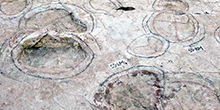
TrackSim was a software package for simulating how quadrupedal dinosaurs walked, using large sets of fossilized footprint data. The idea was to simulate a range of possible gaits and then use passive analysis of the results to score how well each gait fit the supplied tracks. Results were displayed in web visualizations to make them easier to interpret. It built on the Cadence work with Dr. Kent Stevens, and the source was published on GitHub.
Show & Tell for Code
Code Tour was a desktop app for creating interactive walkthroughs of code. It grew out of three problems I kept seeing in code explainers: omitting details, chopping code into orphaned fragments, and burying the point in text nobody reads. The app loaded a codebase and let the author build a step-by-step tour with a short audio recording per step, no text outside the code, and control over which characters were visible, highlighted, or underlined. I built it after years of teaching and struggling with those same failures myself.

Online Reader for Language Learning
Lingua-Ex was a web app for learning a language by reading stories one sentence at a time. I started it because the well-known language tools I tried felt like enhanced flashcards, and I was not advanced enough in German to read or listen to native content comfortably. Each sentence appeared alone with audio that could be replayed as often as needed, and tapping a word showed its translation. It stayed a side project with an immature interface, and creating the content was the hardest part.

Data Science Toolkit for Paleontology
Cadence was a paleontological toolkit for statistical analysis and probabilistic modeling of dinosaur locomotion from trace fossils. Road construction in the Swiss Jura uncovered more than 15,000 dinosaur tracks, excavated and mapped over nearly a decade. Beginning in 2012, my colleague Dr. Kent Stevens and I were asked to analyze the trackway data. Starting in 2013 we ran a large-scale statistical analysis and simulation-based study of the track-makers. Cadence gathered the data from many sources into one database-driven 3D viewing environment, because the tools had to exist before the research could happen.
Create Animated Text Videos on Your Mobile Device
Letters in Motion was an iOS and Android app for making motion typography videos on a touchscreen. I built it in 2013 after years of making text animations, including a book trailer and a physics teaching video on uncertainty and units, in tools that were not designed for the job. The app aimed at a workflow built around text. I eventually stopped working on it because phones of the time were not powerful enough, and the operating systems made asset storage and video rendering awkward.

Traveling Exhibit by the Tokyo Museum of Natural History
This was a scientific visualization of how an adult Tyrannosaurus rex could have sat down and stood up despite its size and tiny arms. I built the animation from physical constraints, mainly kinematic but also accounting for dynamics in the fast phases of the motion. The result showed the heavy tail balancing the front of the body around the pelvis like a teeter-totter, with the animal rocking to build the momentum it needed to get up. It was made for a permanent exhibit at the Tokyo Museum of Natural History and later toured other museums in Asia.
Visual Effects: National Geographic Explorer Television
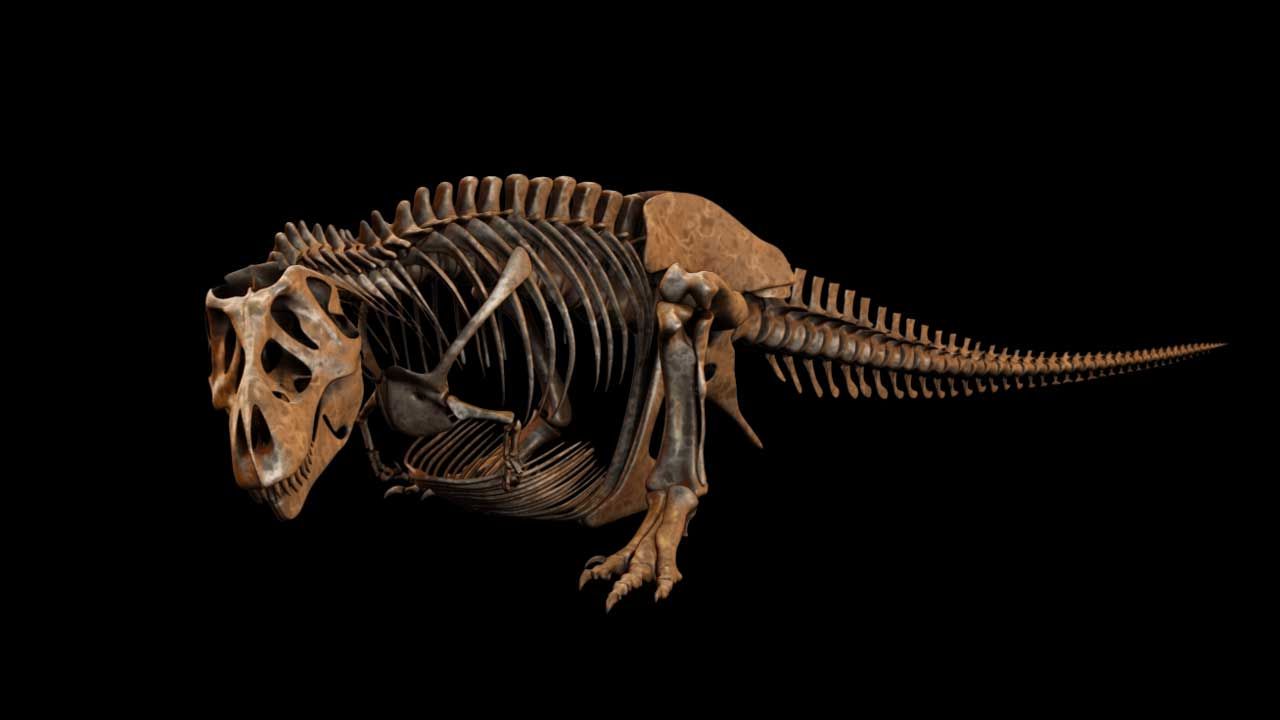
I worked as a visual effects artist, with my colleague Kent Stevens, on an episode of National Geographic Explorer about how Tyrannosaurus rex walked and how it changed from infant to adult. Our scientific visualizations showed the skeleton morphing as the animal grew, with the camera zooming out to hold apparent size constant so the change in proportions was easy to see. For example, the legs became shorter and less suited to running. Our work was the basis for the robotic baby T. rex built throughout the show.

A character animation engine with integrated machine learning capabilities
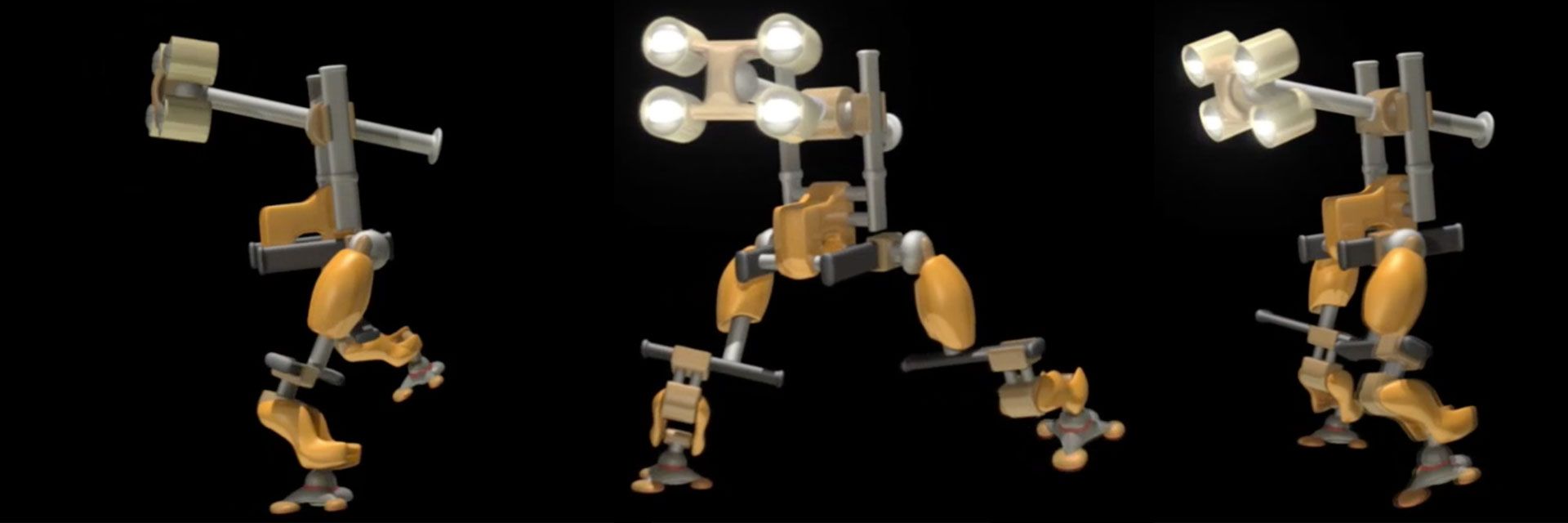
Agility was a character animation engine built with a few colleagues at the startup Kaibridge to improve the quality and productivity of the CG animation pipeline. Machine learning lived inside the animation rigs. Animators recorded a few simple moves, the rig learned each character’s movement preferences and used them to fill in later tweens, and a genetic algorithm could then produce full-body locomotion on its own. Early tests on an unusual robot body plan produced viable walks in under a minute on a consumer laptop. The engine was a casualty of the recession before it could become a product.
Scientific Visualizations of Dinosaurs
Over several years I created scientific visualizations of dinosaur locomotion for museums and news outlets. One project was a permanent interactive exhibit at the Carnegie Museum of Natural History covering the locomotion of Tyrannosaurus rex, Apatosaurus, and Triceratops, including a clip showing why the old upright Godzilla pose conflicts with the animal’s muscle attachments. A few years later my colleagues and I developed an updated T. rex walk cycle for a permanent exhibit at the Los Angeles Museum of Natural History, which also became a clip for a National Public Radio story.