Maestro Loop Clock
What one big, successful software task looks like from the inside when 72 agents do the building, charted as a clock of loops nested inside loops.
Opens the standalone artifact full screen.
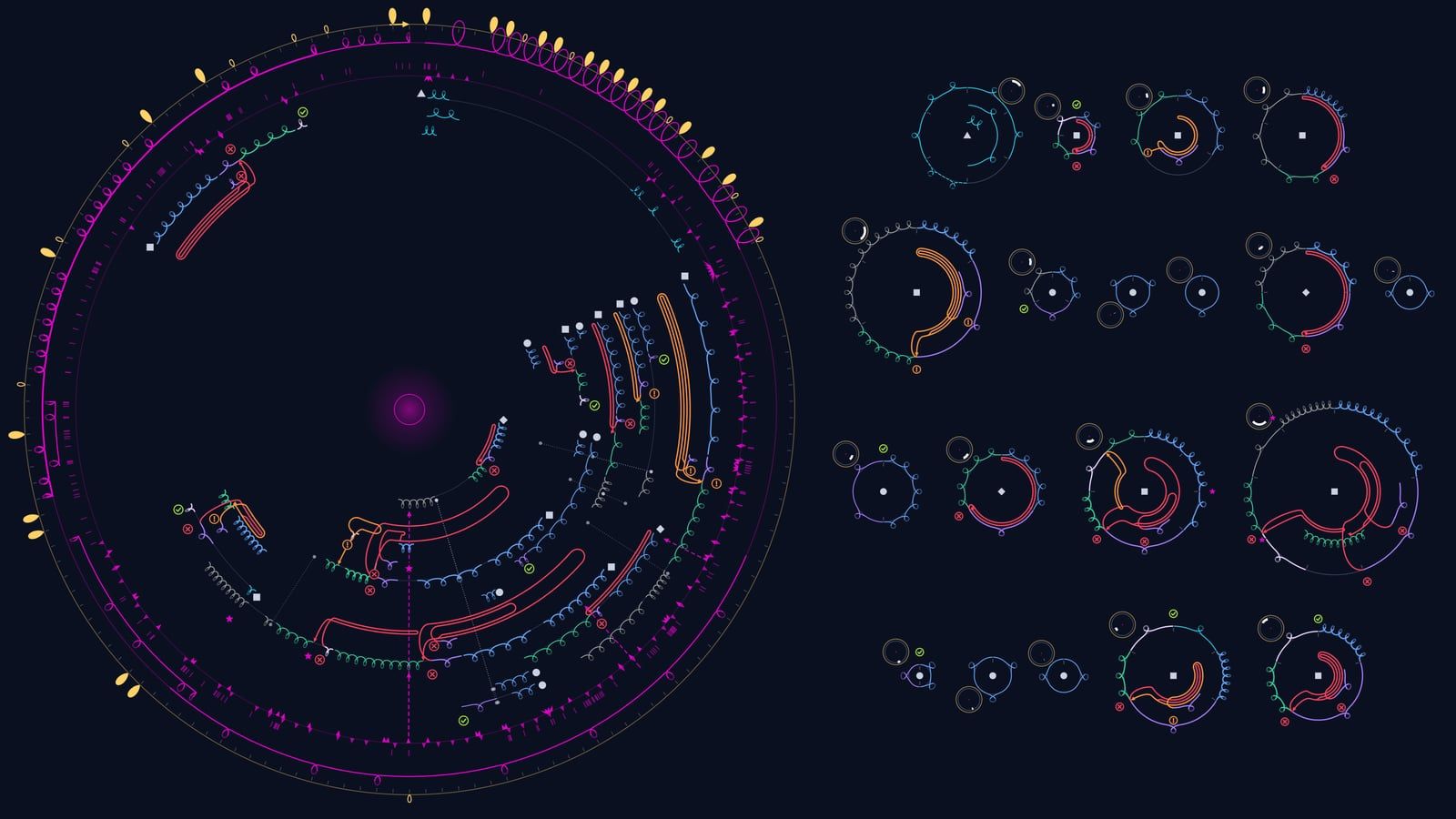
This is what one big, successful software task looks like from the inside when agents do the building. Over three days (Sep 24–26, 2026), one orchestrating agent, a Claude Code maestro, dispatched 71 subagents across 19 workstreams in roughly 15 active hours, planning, building, reviewing and shipping 22 pull requests. I steered it, stepping in 36 times at the moments that mattered and letting the rest run on its own. The clock is a picture of all of it.
The claim behind the picture is that reliable agent-driven software comes from loops nested inside loops. There are four levels, and each one is drawn on the clock:
- Human and maestro: each petal leaving the outer ring and returning is one human turn. 24 of the 36 turns were steering inputs; the other 12 were go-ahead gates (10 approvals and 2 resumes).
- Maestro: a pink coil is one work episode, and each loop in it is one iteration.
- Workstream: an execute, judge, fix, re-judge cycle. A rejection leaves the judge’s verdict as a curl and sweeps back under the work it reviewed, and consecutive rejections nest as concentric curls. There were 17 rejection loops in all.
- Agent: each agent is an arc wound with a tool coil, one loop per 40 tool calls. The agents made 6,842 tool calls between them (204 coil loops).
How to read it
Position around the clock is mission progress, never wall-clock time: one notch per completed iteration, 146 in all (36 human turns, 71 agent completions and 39 maestro iterations). Colour tells you the role of an agent (executor, judge, re-judge, fix, ops or scout) and stroke weight tells you the model tier: heavy for Opus, medium for Sonnet, dashed for Haiku. Verdicts are shapes, not just colours: a × in a circle with a red curl is a reject, a ! with an orange curl is findings, and a ✓ with no curl is a pass.
On the right, each of the 19 workstreams is redrawn as its own complete loop, with a small locator clock showing where it sits on the big one. The full page also has a key, a workstream index, the steering inputs and the numbers behind all of this (22 PRs, 2 of them direct).
Open it, read the wedge guide first, and then go find the rejection curls. Tell me what you see.